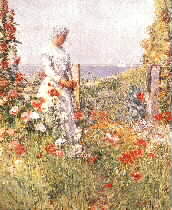
Characteristics
Setting: The emphasis is frequently on nature and the
limitations it imposes; settings are frequently remote and inaccessible. The
setting is integral to the story and may sometimes become a character in itself.
Characters: Local color stories tend to be
concerned with the character of the district or region rather than with the
individual: characters may become character types, sometimes quaint or
stereotypical. The characters are marked by their adherence to the old ways, by
dialect, and by particular personality traits central to the region. In women's
local color fiction, the heroines are often unmarried women or young girls.
Narrator: The narrator is typically an
educated observer from the world beyond who learns something from the characters
while preserving a sometimes sympathetic, sometimes ironic distance from them.
The narrator serves as mediator between the rural folk of the tale and the urban
audience to whom the tale is directed.
Plots. It has been said that "nothing
happens" in local color stories by women authors, and often very little does
happen. Stories may include lots of storytelling and revolve around the
community and its rituals.
Themes: Many local color stories share an
antipathy to change and a certain degree of nostalgia for an always-past golden
age. A celebration of community and acceptance in the face of adversity
characterizes women's local color fiction. Thematic tension or conflict between
urban ways and old-fashioned rural values is often symbolized by the intrusion
of an outsider or interloper who seeks something from the community.
Return to top
Techniques -
Use of dialect to establish credibility and
authenticity of regional characters.
Use of detailed description, especially of small, seemingly
insignificant details central to an understanding of the region.
Frequent use of a frame story in which the narrator hears some
tale of the region.
Return to top
Local Color defined
Local color or
regional literature is fiction and poetry that
focuses on the characters, dialect, customs, topography, and other features
particular to a specific region. Influenced by
Southwestern and
Down East humor, between the Civil War and the end of the nineteenth century
this mode of writing became dominant in American literature. According to the
Oxford Companion to American Literature,
"In local-color literature one finds the dual influence of
romanticism and realism, since the author frequently looks away from ordinary
life to distant lands, strange customs, or exotic scenes, but retains through
minute detail a sense of fidelity and accuracy of description" (439). Its
weaknesses may include nostalgia or sentimentality. Its customary form is the
sketch or short story, although
Hamlin Garland
argued for the novel of local color.
Regional literature
incorporates the broader concept of sectional differences, although Judith
Fetterley and Marjorie Pryse have argued convincingly that the distinguishing
characteristic that separates "local color" writers from "regional" writers is
instead the exploitation of and condescension toward their subjects that the
local color writers demonstrate.
One definition of the difference between
realism and local
color is Eric Sundquist's: "Economic or political
power can itself be seen to be definitive of a realist aesthetic, in that those
in power (say, white urban males) have been more often judged 'realists,' while
those removed from the seats of power (say, Midwesterners, blacks, immigrants,
or women) have been categorized as regionalists." See also the definition
from the
Encyclopedia
of Southern Literature.
Many critics, including Amy Kaplan ("Nation, Region, and
Empire" in the Columbia Literary History of the
United States) and Richard Brodhead (Cultures
of Letters), have argued that this literary movement
contributed to the reunification of the country after the Civil War and to the
building of national identity toward the end of the nineteenth century.
According to Brodhead, "regionalism's representation of vernacular cultures as
enclaves of tradition insulated from larger cultural contact is palpably a
fiction . . . its public function was not just to mourn lost cultures but to
purvey a certain story of contemporary cultures and of the relations among them"
(121). In chronicling the nation's stories about its regions and mythical
origins, local color fiction through its presence--and, later, its
absence--contributed to the narrative of unified nationhood that late
nineteenth-century America sought to construct.
A variation of this genre is the
"plantation tradition"
fiction of Thomas Nelson Page and others.
Return to top
Local Color Authors
1865-1895
Prominent African-American writers
such as
Charles W. Chesnutt and
Frances
E. W. Harper demythologize and satirize portions of the
"plantation tradition" in their works.. See especially Chesnutt's "The
Goophered Grapevine," the first story published by an African American in
the Atlantic Monthly Magazine (1887), and the stories in his
The Conjure Woman (1899).